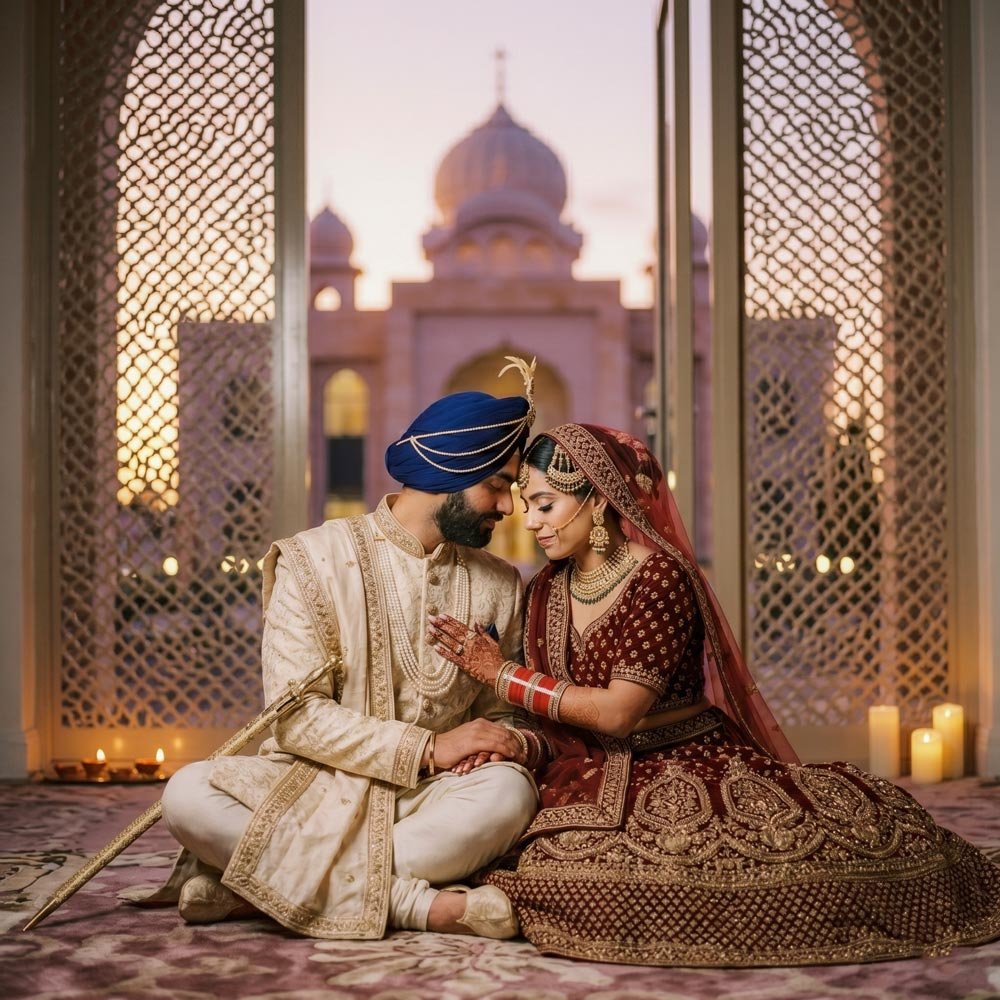
The quietest moment in a Sikh wedding is often the one that carries the most weight. Inside the gurdwara, before the first Laava begins, the atmosphere shifts – less performance, more presence. For couples planning Sikh wedding photography in Melbourne: a guide to capturing the Anand Karaj begins with understanding that this is not a staged centrepiece of the day. It is a sacred ceremony built on devotion, humility, family, and spiritual union.
That distinction changes everything about how it should be photographed.
An Anand Karaj is visually beautiful, but beauty alone is not the brief. The ceremony is layered with meaning, and each moment unfolds within a framework of reverence. A photographer who only sees colour, scale, and attire will miss the deeper narrative. A team with cultural fluency knows when to step back, when to anticipate, and when a subtle expression from a parent or grandparent holds as much emotional weight as the main ritual itself.
In Melbourne, Sikh weddings often blend local logistics with deeply rooted Punjabi tradition. Some celebrations are intimate and understated. Others are expansive, multi-day productions with a large guest count, pre-wedding events, and a reception of considerable grandeur. The Anand Karaj, however, remains its own emotional register. It calls for restraint, awareness, and technical discipline.
Every gurdwara has its own spatial character, house rules, and practical considerations. Light may be soft and natural in one setting, while another may be more enclosed, with mixed indoor lighting and limited movement for photographers. This is where experience matters. Capturing the Anand Karaj well is rarely about dominating the room with equipment. It is about reading the environment and working with precision, discretion, and respect.
The ceremony itself is not fast, but it is deeply rhythmic. The arrival of the families, the seated anticipation, the exchange of glances, the blessings, and then the Laavan – each stage carries its own emotional tempo. A strong visual narrative does not treat these as isolated moments. It builds continuity. The imagery should feel intentional from the first frame to the final blessing.
That means paying attention to the details that shape memory. The drape of the bride’s dupatta as she enters. The stillness of the groom before the ceremony begins. The way elders watch with pride that is both quiet and immense. These are not fillers between key events. They are part of the emotional architecture of the day.
The first responsibility is not creative – it is cultural. Photography inside a gurdwara must always honour the sanctity of the space. That includes appropriate attire, respectful positioning, and awareness of where movement is and is not suitable. Couples should feel that their photography team understands these expectations without needing constant direction.
This respect also influences the visual style. Heavy intrusion, excessive repositioning, or overt interruption can fracture the atmosphere of the ceremony. The strongest coverage feels almost invisible. It preserves intimacy rather than competing with it.
The Anand Karaj rewards observation. Because the ceremony is measured and meaningful, the most compelling images often come from anticipation rather than split-second reaction. A seasoned photographer reads body language, understands when a family member is about to become emotional, and senses the subtle transitions between ritual moments.
That is particularly true during the Laavan. Photographing each circumambulation with consistency matters, but repetition alone is not enough. The real craft lies in creating variation without disturbing the sanctity of the moment – wide frames that establish the ceremonial space, medium compositions that show connection, and intimate close-ups that reveal emotion.
Luxury wedding imagery is not created by overworking a sacred moment. It comes from restraint. In Sikh wedding photography, especially during the Anand Karaj, light should be handled with care. Skin tones, fabric texture, gold embroidery, and architectural details all need to be rendered with clarity and softness.
Melbourne venues and gurdwaras can vary considerably in ambient light, so technical confidence is essential. Some spaces call for a quieter, documentary-led approach. Others allow for more editorial depth in the portraits before or after the ceremony. It depends on the location, the timeline, and the level of access. The point is not to force one style onto every wedding. It is to shape the visual language around the couple and the setting.
Most couples expect the major ceremonial frames. What they do not always anticipate is how much the surrounding moments come to define the final gallery.
The tying of the palla carries tenderness and symbolism. The bride seated with composed emotion before the ceremony often creates some of the most timeless imagery of the day. Parents adjusting an outfit, siblings exchanging a knowing glance, or relatives gathered in prayer can hold extraordinary depth. These are the frames that transform wedding coverage into family legacy.
There is also the transition after the ceremony, which can be emotionally rich in a different way. The release in everyone’s expressions, the warmth of congratulations, the quieter portraits with immediate family – these moments often feel less formal and more revealing. When photographed with editorial sensitivity, they bring balance to the grandeur of the wider celebration.
A refined result begins long before the wedding day. For Sikh weddings, timeline planning should protect the integrity of the Anand Karaj rather than compress it.
If portraits are scheduled too tightly, the morning can feel rushed. If travel between locations is underestimated, the couple arrives already managing stress. If family formalities are left vague, important combinations can become chaotic after the ceremony. None of this is dramatic on paper, but it affects how the day feels – and that feeling is always visible in the imagery.
The most successful coverage is built around a realistic flow. Space for bridal and groom preparations. Enough time for family arrivals. Clear communication with the gurdwara regarding ceremony guidelines. A thoughtful plan for portraits that complements, rather than competes with, the spiritual centre of the day.
For larger Melbourne weddings, this level of orchestration is even more valuable. Guest movement, traffic between venues, and the scale of family involvement all need to be factored in with calm precision. Premium coverage is not only about the camera. It is about managing complexity so the couple can remain present.
A beautiful portfolio matters, but with Sikh weddings, understanding tradition is just as important as visual polish. A photographer may produce striking portraits and still struggle inside a ceremonial setting if they do not understand the rhythm and etiquette of the Anand Karaj.
Ask how they approach sacred ceremonies. Ask how they photograph in a way that remains respectful while still delivering editorial quality. Ask how they manage large family structures and multi-event celebrations. The answers should feel assured, specific, and grounded in real experience.
Many couples are drawn to dramatic reception imagery, and rightly so. But the real test is whether a studio can carry the same level of artistry into quieter, more sacred moments. The transition from morning preparations to ceremony, then to portraits and evening celebration, should feel cohesive.
That consistency is what gives a wedding gallery its cinematic strength. It should not feel like separate albums stitched together. It should feel like one refined, emotionally intelligent story.
Melbourne offers a distinctive backdrop for Sikh weddings because it allows both tradition and contemporary luxury to sit comfortably together. A ceremony in the gurdwara can be followed by portraits in architecturally clean spaces, lush gardens, or grand reception venues with strong editorial presence. For couples who value heritage and high design in equal measure, that contrast photographs beautifully.
Still, location should never overshadow the heart of the day. The Anand Karaj is the anchor. Everything else – fashion, styling, venue design, reception scale – gains meaning because of what happens there.
When photographed with care, a Sikh wedding does more than document a ceremony. It preserves the dignity of tradition, the intimacy of family, and the atmosphere of a once-in-a-lifetime union with the depth it deserves. That is the standard couples should expect from Sikh wedding photography in Melbourne, and it is the difference between simply covering a wedding and crafting a visual legacy.
The most enduring images are rarely the loudest. They are the ones that still feel sacred years later.
