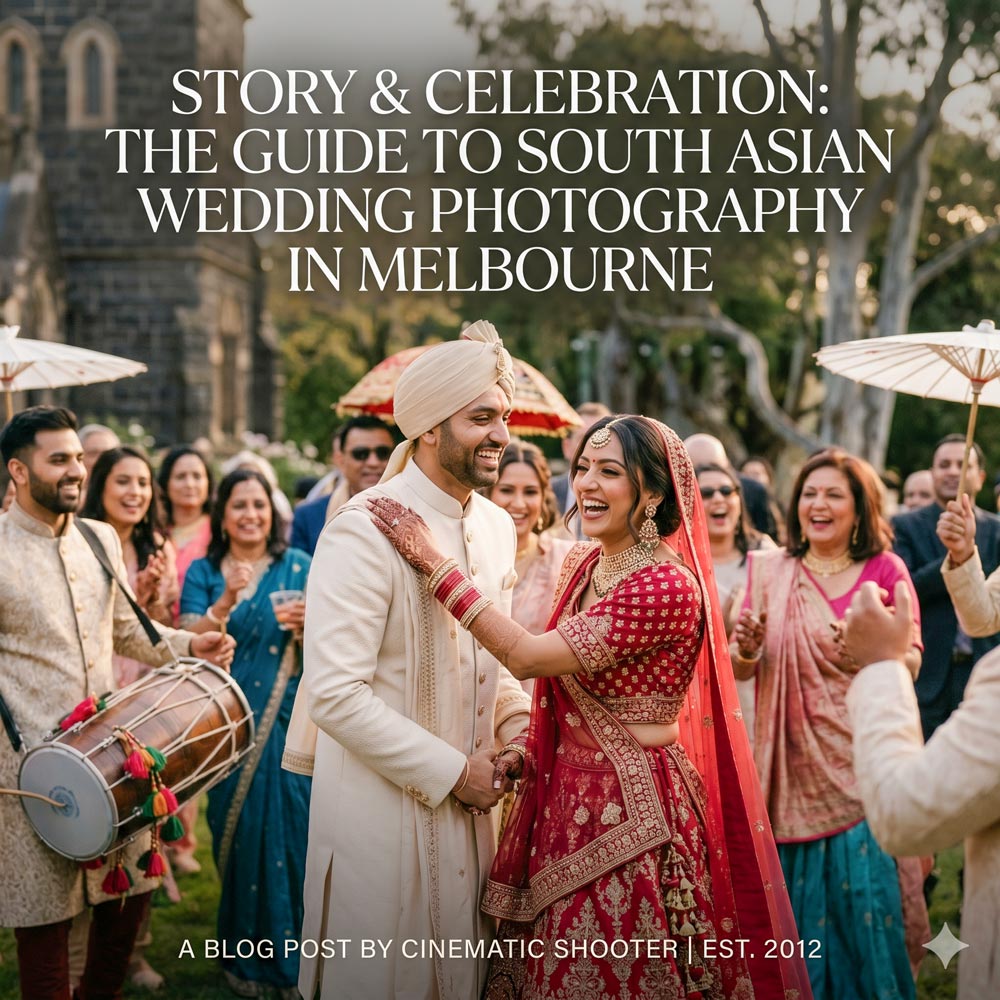
A South Asian wedding rarely unfolds in a straight line. It arrives in layers – the pulse of the dhol, the stillness before the Anand Karaj, the intimacy of a Nikkah, the colour and movement of a Hindu mandap ceremony, the electricity of a packed reception dance floor. That is why the ultimate guide to South Asian wedding photography in Melbourne cannot begin with cameras or gear. It begins with understanding rhythm, heritage, family dynamics, and the scale of what is truly being entrusted to your photographer.
For couples planning a wedding of cultural depth and visual ambition, photography is not simply about coverage. It is about preservation with discernment. The finest images do more than show what happened. They honour how it felt, how it looked, and why each ritual mattered.
Melbourne offers extraordinary venues, diverse light, and a rich multicultural wedding landscape, but South Asian celebrations bring a complexity that demands more than general wedding experience. A multi-day Indian, Sikh, Pakistani, Nepali, or Muslim wedding often moves across homes, temples, gurdwaras, mosques, hotels, ballrooms, and outdoor portrait locations. Each environment requires a different photographic instinct.
There is also the matter of tempo. A Western ceremony may build towards one central exchange. South Asian weddings often contain many emotional peaks across several days – roka or engagement events, haldi, mehndi, sangeet, jaggo, Maiyan, Baraat, milni, ceremony, reception, and post-wedding gatherings. Miss one key transition and the visual narrative feels incomplete.
The most accomplished teams work with cultural fluency, not just logistical competence. They know when elders become central to the frame, when footwear must be noted, when prayer demands discretion, and when the room will shift from sacred restraint to full celebration in seconds.
Luxury wedding imagery should feel editorial, but never staged to the point of emotional emptiness. The strongest South Asian wedding photography balances grandeur with intimacy. Yes, the lehenga, sherwani, florals, jewellery, and venue styling deserve beautifully composed frames. But so do the quieter gestures – a mother fastening kaleere, a father pausing before the vidaai, siblings laughing during bridal prep, grandparents watching with pride from the edge of the room.
This is where many couples refine their brief. Are you drawn to fashion-led portraiture? Documentary candids? A more cinematic, mood-rich treatment of light? Usually, the answer is not one or the other. It is a layered visual language that allows the wedding to feel both expansive and deeply personal.
A refined photographer will guide you through that balance. They will know when to direct posture, spacing, and body language for portraits, and when to step back so the frame breathes naturally. South Asian weddings need both discipline and sensitivity.
Not all ceremonies can be photographed in the same way, and that has very real consequences for your final gallery. In a Sikh wedding, for instance, the serenity of the gurdwara setting requires respectful movement and awareness of protocol. During a Hindu ceremony, the mandap may involve multiple focal points at once – the couple, the priest, family interaction, offerings, sacred fire, and reaction shots. In a Nikkah, the emotional gravity may sit in subtle exchanges, recitations, signatures, and family presence rather than overt movement.
A photographer unfamiliar with these nuances may still produce attractive images, but they can easily miss significance. The result is a gallery that looks polished yet feels thin. Cultural literacy is what gives the imagery depth.
This matters in Melbourne especially, where many celebrations are beautifully hybrid. A couple may honour one tradition in full, blend several cultural elements, or host a modern reception with deeply traditional ceremonial roots. Your photographer should not need those transitions explained in the moment. They should already understand how to anticipate them.
One of the most common mistakes in large South Asian weddings is underestimating time. Not because the day is disorganised, but because meaningful events rarely move with mechanical precision. Family arrivals shift. Ceremonies breathe. Group portraits expand. Wardrobe changes take longer than expected. Traffic across Melbourne can also affect transitions between locations.
The answer is not to force the wedding into rigid scheduling. It is to build a timeline with photographic intelligence. That means allowing space for bridal and groom preparations, detail imagery, first-look or pre-ceremony portraits if desired, cultural processions, family formals, couple portraits, room reveals, and candid coverage between formalities.
Golden hour portraits often matter, but not at the expense of ceremony coverage or guest experience. Sometimes a dramatic evening portrait with architectural lighting suits the celebration better than chasing soft daylight. It depends on your venue, season, and the emotional flow of the day.
Couples planning multi-day coverage should also think beyond the wedding day itself. Mehndi and haldi events often produce some of the most textured, joyful, and unguarded imagery of the entire celebration. They are not side events. They are part of the narrative.
South Asian weddings are visually rich by nature. Intricate embroidery, layered textiles, gold detailing, florals, ceremonial décor, and large guest counts create a frame filled with information. Photographing that richness well requires restraint as much as flair.
Over-editing can flatten skin tones, distort textile colour, or date the gallery quickly. Heavy filters may look fashionable for a season, then feel disconnected from the elegance of the event. A timeless approach favours true-to-life colour, controlled contrast, beautiful skin rendering, and cinematic depth without visual gimmicks.
That is especially important with bridalwear and ceremonial styling. The reds, ivories, emeralds, champagnes, and jewel tones common in South Asian weddings carry emotional and cultural weight. They should be rendered with care, not treated as an afterthought.
For premium couples, style also extends to composition. Wide frames should establish scale. Tight frames should reveal intimacy. Editorial portraits should feel considered, not stiff. Reception imagery should preserve atmosphere rather than blowing out every light source until the room loses character.
The best choice is rarely the team with the most images online. It is the team whose body of work shows consistency across complexity. Look for galleries that prove they can handle daylight ceremonies, dimly lit receptions, crowded Baraats, emotional family portraits, and fast-moving rituals with equal confidence.
Ask yourself whether the work feels culturally informed or simply visually attractive. There is a difference. Does the photographer understand where emotion tends to gather in your traditions? Can they photograph large families without losing elegance? Can they maintain calm direction while preserving the natural energy of the day?
You should also pay attention to how a studio communicates. Luxury service is not theatre. It is clarity, preparation, and confidence. A strong team will discuss logistics thoughtfully, ask smart questions about ceremony structure, and help shape a plan that supports both artistry and order.
For large weddings, team capacity matters as well. One photographer may produce beautiful portraits, but multi-layered celebrations often need broader coverage to honour simultaneous moments. Groom prep and bridal prep, ceremony detail and guest reaction, wide room coverage and intimate candids – these things can happen at once.
Studios such as Cinematic Shooter, known for large-scale South Asian and multicultural celebrations, understand that premium coverage is as much about orchestration as aesthetics.
Location should serve the story, not compete with it. Melbourne offers heritage architecture, manicured gardens, contemporary interiors, waterfront scenes, and grand reception spaces, but the right portrait setting depends on your wardrobe, timing, and overall visual direction.
A heavily embellished bridal look may sing against understated architecture. A regal sherwani may suit stone textures and strong lines. Some couples want iconic Melbourne energy. Others prefer a quieter backdrop that keeps the focus on attire and connection. Neither is more sophisticated. It simply depends on the visual language you want your gallery to speak.
The practical side matters too. Travel time, weather, parking access, guest flow, and permit requirements can all shape what is realistic. A beautiful plan only works if it protects the wedding experience rather than interrupting it.
When the wedding is over, you are not just receiving images. You are receiving the visual memory your family will return to for decades. The gallery should feel complete, emotionally coherent, and elevated from beginning to end.
That means ceremonial detail without excess, portraits with presence, candid moments with honesty, and a clear sense of atmosphere. It should honour elders and newlyweds alike. It should reflect the scale of the celebration without losing the people at its centre.
The right photography does not reduce a South Asian wedding to spectacle. It gives shape to heritage, intimacy, and grandeur in equal measure. If you choose a team that understands that balance, your photographs will not merely document the day. They will carry its weight, its beauty, and its legacy long after the music fades.
A South Asian wedding is never just an event—it is a living narrative of heritage, emotion, and celebration unfolding across time and space. From sacred rituals to high-energy celebrations, every frame holds meaning.
When photographed with cultural understanding and cinematic intent, the wedding becomes more than documentation. It becomes legacy—preserved with depth, emotion, and timeless beauty.
The right photography does not simply record your day. It carries its story forward for generations.
