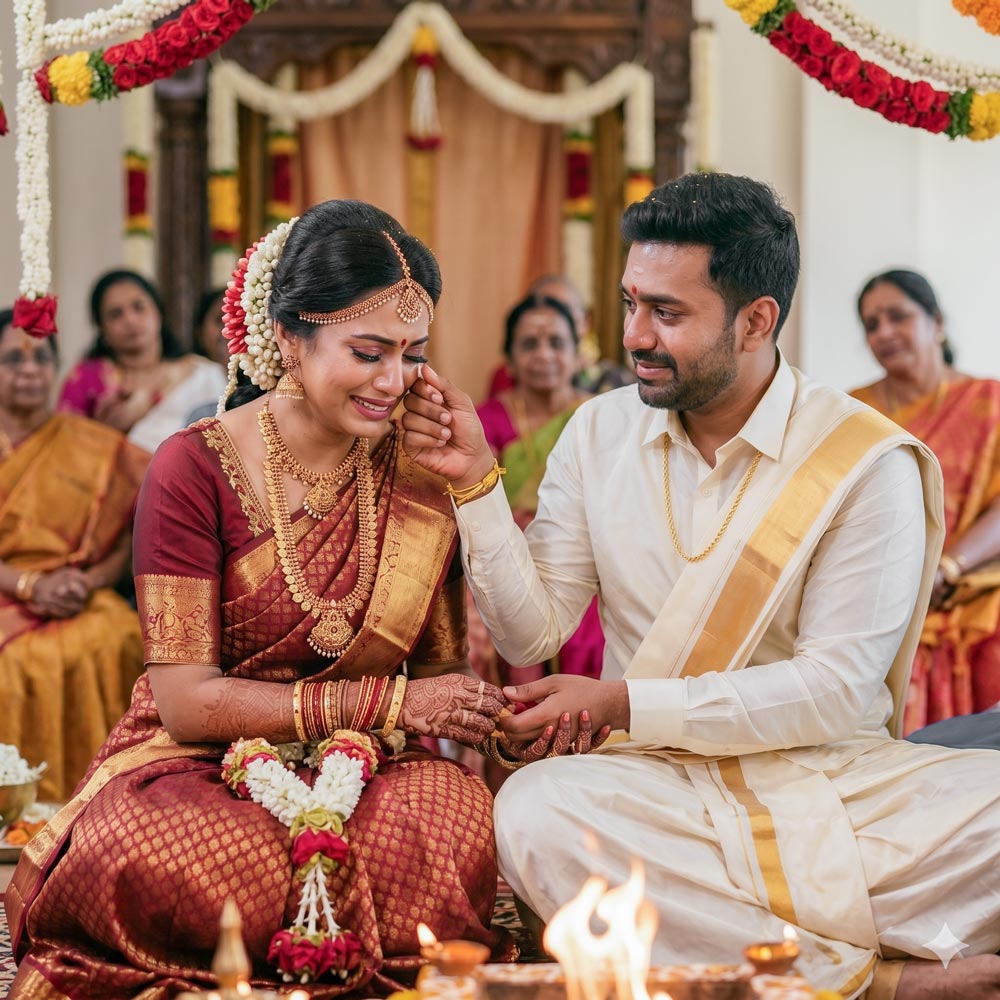
A Tamil or Telugu wedding rarely unfolds in a straight line. It moves with layers – ritual, family politics, reverence, laughter, orchestration, and sudden emotion – often all within the same hour. The art of Tamil and Telugu wedding photography: capturing South Indian traditions lies in reading that rhythm correctly, then translating it into imagery that feels both editorial and deeply personal.
For couples planning a South Indian wedding, that distinction matters. These are not ceremonies that can be covered with generic event instincts. The visual story must hold grandeur and intimacy at once. It must understand when a frame needs architectural scale, when it needs restraint, and when the smallest gesture between generations carries more weight than the stage itself.
Tamil and Telugu weddings are rich in symbolic detail, but they do not always move at the same pace or carry the same visual priorities. Even within each community, family customs, sect, region, and venue style can change how the day unfolds. A photographer who approaches them as a single category of “South Indian wedding” will almost always miss nuance.
In Tamil ceremonies, visual storytelling often leans into sacred precision. The rhythm of rituals can be measured, formal, and deeply rooted in temple aesthetics, Vedic structure, and familial reverence. Telugu weddings, while equally ceremonial, may carry a different cadence in specific rituals, with distinct family interactions, decorative styling, and moments of heightened theatricality. Neither is better or more photogenic than the other. They simply ask for different observational instincts.
That is where experience becomes visible in the final gallery. It shows in whether the photographer anticipates the emotional beat before the gesture happens, whether they understand where elders will sit, where sacred items will be placed, and how to frame a ritual without flattening its meaning into a checklist image.
Luxury wedding coverage is not about taking more photographs. It is about knowing which moments deserve visual emphasis and which ones should breathe. In South Indian weddings, many of the most significant frames happen in transitions – not only in the headline rituals.
The bride pausing before entering. A father adjusting the pallu with quiet concentration. Jasmine woven into hair under soft morning light. The priest preparing ceremonial items before guests fully settle. Gold, silk, turmeric, kumkum, coconuts, garlands, and fire all carry texture, but texture alone is not storytelling. These details matter because they belong to a larger emotional and cultural sequence.
The strongest wedding imagery does not isolate tradition from feeling. It shows how ritual lives through people. A close portrait of intricate temple jewellery can be beautiful, but it becomes powerful when placed within the broader narrative of preparation, blessing, anticipation, and family memory.
Certain moments in Tamil and Telugu weddings cannot be recreated with authenticity. The tying of the thaali or mangalsutra, garland exchanges, Kanyadanam, Jeelakarra Bellam, Saptapadi, Talambralu, blessings from elders – each arrives with a specific visual and emotional tempo. The challenge is not simply to photograph them clearly. It is to preserve their gravity while also showing the surrounding human response.
A technically correct image of a ritual may still feel incomplete if the frame ignores the mother watching from the side, the tears held back by a sibling, or the burst of laughter after a formal exchange. The ceremony exists in the centre, but the meaning often radiates outward.
One of the most delicate balances in wedding photography is direction. Luxury couples often want refinement, but South Indian ceremonies cannot be over-directed without losing integrity. The best approach is controlled observation – knowing when to shape a frame and when to disappear into the movement of the day.
This is especially important during multi-day celebrations. Pre-wedding functions may allow more room for stylised portraiture, fashion-led compositions, and cinematic lighting. The wedding ceremony itself usually asks for a quieter hand. Sacred rituals should never feel interrupted for the sake of a better angle.
That does not mean the imagery has to be passive. It means direction happens with respect. A slight repositioning before a ceremony begins, guidance around natural light during bridal preparation, or a carefully planned couple session between events can create editorial quality without disturbing tradition.
Tamil and Telugu weddings are visually generous. Kanjeevaram silks, rich reds, turmeric yellows, ivory florals, temple gold, polished wood, and vivid drapery create an extraordinary palette. Yet this richness can easily become visually heavy if photographed without discipline.
A refined photographic approach manages colour rather than competing with it. Skin tones must remain true. Gold should feel luminous, not harsh. Red should hold depth, not oversaturate. White veshtis and cream ceremonial fabrics require careful exposure, particularly in mixed lighting environments such as wedding halls, homes, and mandaps dressed with LED and ambient fixtures.
This is where a cinematic eye becomes essential. Strong South Indian wedding photography understands contrast, spatial balance, and mood. It honours the opulence of the setting while protecting the emotional realism of the moment.
Couples planning luxury weddings often want portraits that feel timeless rather than overly staged. In Tamil and Telugu wedding coverage, the most compelling portraits are those that recognise heritage as part of the composition.
That might mean using carved temple-inspired architecture, the symmetry of a mandap, the geometry of floral installations, or the quiet dignity of early morning preparation spaces. It may also mean allowing wardrobe and adornment to lead the visual language. A bridal portrait is not only about expression. It is about silk movement, jewellery placement, posture, and atmosphere.
The same applies to family portraiture. In South Indian weddings, family photographs are not administrative obligations. They are legacy frames. Grandparents, extended family, and intergenerational groupings carry enormous archival value, especially in celebrations where relatives have travelled from across Australia or overseas. These portraits should feel polished, efficient, and elegant – never rushed, never chaotic.
Many Tamil and Telugu weddings are expansive by design. The guest count, decor, ceremony structure, and reception styling can all operate on a grand scale. A complete visual narrative must therefore move fluidly between intimacy and spectacle.
Wide frames establish the architecture of the celebration – the mandap, the crowd, the stage design, the atmosphere of arrival. Tighter frames reveal the emotional core. If coverage stays too wide, the wedding feels impressive but distant. If it stays too close, the scale and grandeur disappear. The art is in balancing both.
For large-format multicultural weddings in Melbourne and across Australia, this becomes even more important. Venue scale, lighting conditions, run sheets, and family expectations can all vary dramatically. The visual team has to think like storytellers, but also like producers.
Style matters, but cultural confidence matters more. A beautiful portfolio means little if the team does not understand when to move, when to stay still, when to prioritise elders, and when a so-called minor ritual is actually central to the family.
Couples should look for work that shows emotional range, not just decorative beauty. Do the images hold ceremony with dignity? Do family moments feel observed rather than manufactured? Does the photography preserve the richness of tradition without turning it into visual clutter? Those are stronger indicators of mastery than dramatic angles alone.
At the luxury end of the market, service also shapes the experience. Complex South Indian weddings require calm communication, efficient coordination, and the ability to collaborate with planners, priests, families, and videography teams without friction. The result should feel composed from start to finish.
For studios like Cinematic Shooter, that standard is not an add-on. It is the foundation of how a visual legacy is built.
Years after the wedding, couples rarely return to their photographs only for the hero portraits. They return for the unrepeatable things – the blessing from an elder who is no longer here, the softness in a parent’s face before the ceremony begins, the precise cultural details they were too overwhelmed to fully see on the day.
That is why this work deserves more than coverage. The finest Tamil and Telugu wedding photography preserves not just what happened, but how heritage felt in motion – intimate, ceremonial, and alive. When that is done well, the imagery does more than document a celebration. It becomes part of the family history itself.
And that is the standard worth choosing: photographs that honour the scale of the day, the sanctity of the rituals, and the people who gave those traditions their meaning.
Based in Craigieburn, we proudly capture Tamil, Telugu and South Indian weddings for couples across Melbourne’s diverse multicultural communities. We regularly serve celebrations throughout Tarneit, Truganina, Point Cook, Werribee, Sunshine, Dandenong, Keysborough, Footscray, Coburg and Broadmeadows, documenting South Indian weddings with a cinematic yet culturally respectful approach. From intimate temple ceremonies to grand multi-day wedding events, our focus is on preserving the emotion, heritage and visual richness that define Tamil and Telugu celebrations across Melbourne and Australia-wide.
