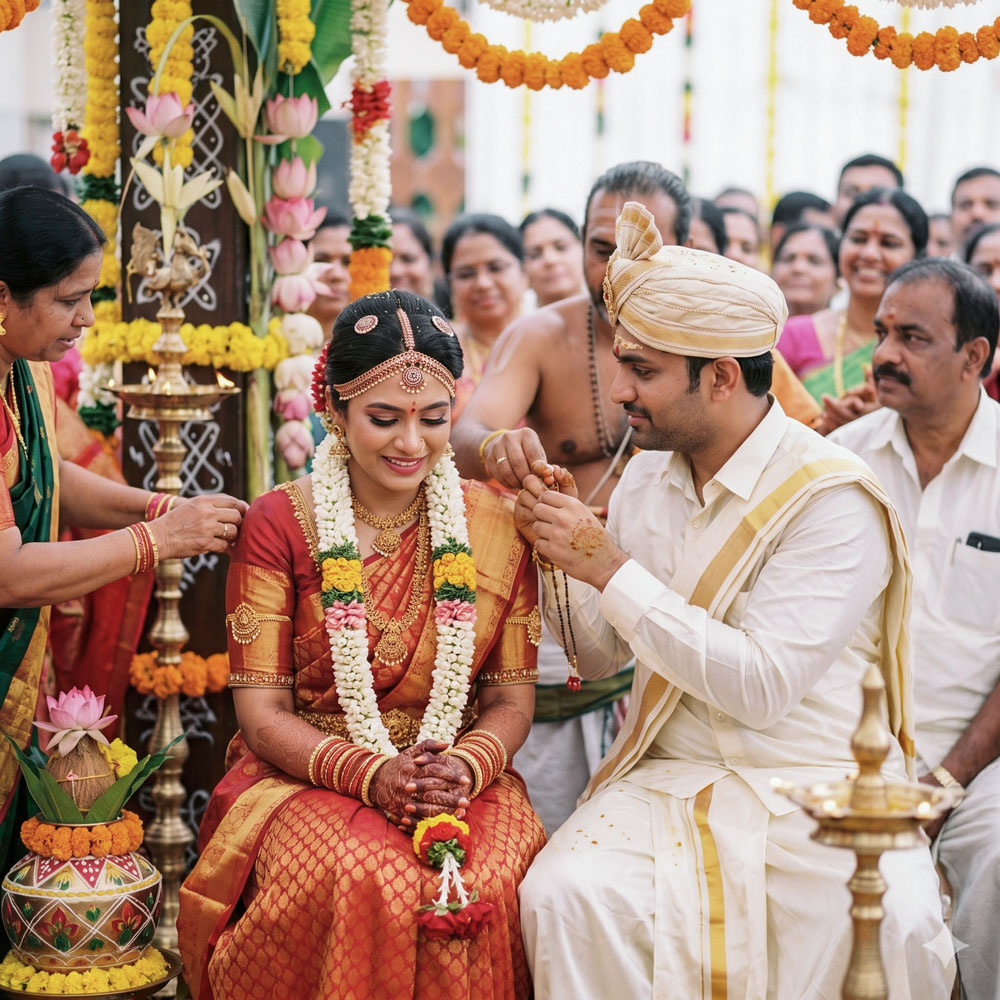
A Tamil or Telugu wedding does not unfold in a single dramatic moment. It builds through rhythm, ritual, family presence and layers of meaning that can shift from quiet devotion to pure celebration within minutes. That is why tamil and telugu wedding ceremonies: essential moments your photographer must capture is not simply a checklist topic – it is a question of cultural fluency, timing and visual instinct.
In these ceremonies, the most valuable images are rarely just the obvious portraits. They are the frames that preserve heritage and emotion together – the priest guiding the sequence, a mother adjusting the bride’s saree, the anticipation before the mangalsutra is tied, the blessing of elders whose expressions carry decades of memory. For couples investing in luxury wedding coverage, this distinction matters. You are not preserving an event. You are preserving a lineage.
Tamil and Telugu weddings are often fast-moving, deeply symbolic and family-led. Many rituals happen in close succession, sometimes beneath a mandap filled with movement, layered décor and a large number of key participants. A photographer who only reacts after a moment begins will already be late.
The strongest coverage comes from understanding sequence, not just aesthetics. When the team knows what is coming next, where the principal family members will stand and which ritual carries emotional weight, the imagery becomes more than decorative. It becomes narratively complete.
This is especially important in multicultural celebrations across Melbourne and wider Australia, where timelines can be adapted to venue logistics while still honouring tradition. In those settings, experience matters because the ceremony may be compressed, blended or staged across multiple locations, yet the significance of each ritual remains unchanged.
Before the core wedding rites begin, the visual language of the day is already forming. The groom’s arrival, family welcome, temple or mandap details, floral installations, garlands, heirloom jewellery and ceremonial items all establish context. These are not filler shots. They ground the story.
For Tamil weddings, this may include the groom’s entrance and welcoming rituals that set the spiritual tone. For Telugu weddings, family interactions at the mandap and preparation of ritual items often hold equal visual importance. A refined photographer captures these scenes with restraint and clarity, allowing the richness of texture, colour and anticipation to breathe.
Luxury wedding storytelling begins well before the ceremony proper. The bride being draped, her final jewellery adjustments, sacred items being handed to her, and private family exchanges often carry a tenderness that contrasts beautifully with the grandeur to come.
The groom’s preparation deserves the same attention. Traditional attire, blessings from parents, the fastening of accessories and the quiet confidence before he steps into the ceremony all add dimension to the final gallery. These images matter because they reveal character, not just costume.
In many Tamil weddings, Kashi Yatra is one of the most character-filled rituals to photograph. The groom symbolically prepares to renounce worldly life, only to be persuaded back into marriage by the bride’s family. It brings humour, theatre and cultural depth into the narrative.
This moment works best when captured both wide and close. The wide frame shows the action and surrounding family energy. The close frame preserves expression – a knowing smile, laughter from elders, the groom’s posture as he plays his role. These details turn tradition into a living scene rather than a staged record.
For Telugu weddings, jeelakarra bellam is one of the defining moments. The couple place a paste of cumin and jaggery on each other’s heads, symbolising inseparability through life’s bitter and sweet experiences. It is visually subtle but emotionally substantial.
A photographer must be ready for the exact instant of contact, but the surrounding seconds matter just as much. The priest’s instruction, the couple’s concentration and the family watching with reverence create the emotional architecture of the frame. Without those supporting moments, the ritual can appear isolated rather than meaningful.
The exchange of garlands is often spirited, elegant and highly photogenic. It carries symbolism, but it also brings a natural shift in energy. Family encouragement, laughter and movement create a more relaxed visual tempo after the ceremony’s formal build-up.
Because this ritual can happen quickly, position is everything. The strongest imagery usually combines one composed frame that honours symmetry and tradition, followed by more documentary frames that capture spontaneity. The balance depends on the couple’s style, but both approaches have value.
If there is one part of the ceremony where emotional intelligence matters as much as technical skill, it is kanyadanam. This is not a moment to photograph mechanically. It is a transfer of care, trust and blessing, often felt most deeply by parents.
The essential images are not limited to the ritual act itself. Hands joined together, the bride’s expression as she looks toward her family, a father holding composure, a mother in quiet reflection – these are the frames couples return to years later. In premium coverage, emotion is never treated as a side note.
This is one of the most anticipated moments in both Tamil and Telugu wedding ceremonies. The tying of the mangalsutra, often accompanied by music, blessings and heightened family energy, must be covered with absolute precision.
A single angle is rarely enough. The central frame of the knot being tied is crucial, but so are the bride’s expression, the reaction of parents and the immediate burst of celebration around the mandap. Timing here is non-negotiable. Once missed, the moment cannot be recreated with integrity.
In Telugu weddings, talambralu brings movement, joy and visual texture as the couple shower each other with rice, often mixed with turmeric or petals. It is one of those rituals where a photographer can create imagery that feels both editorial and alive.
The challenge is that playful moments can become visually chaotic if not framed well. Strong coverage preserves the ritual’s exuberance while still keeping the couple as the visual anchor. The result should feel elevated, not cluttered.
The seven steps are among the most symbolically important parts of a Hindu wedding. In both Tamil and Telugu contexts, the exact presentation may vary, but the ritual remains a profound declaration of shared vows and partnership.
This is where storytelling discipline matters. It is tempting to reduce the ritual to one or two frames, yet the progression itself carries meaning. The steps, the priest’s guidance, the couple’s body language and the family’s attentive presence together create a sequence that deserves thoughtful documentation.
After the major rites, many couples move into a quieter but equally meaningful chapter – receiving blessings from parents, grandparents and senior relatives. These interactions can be brief, and because they are less theatrical than the central rituals, inexperienced teams sometimes underplay them.
That is a mistake. In heritage-rich weddings, these are often the photographs that gain value over time. A bowed head, a hand placed gently in blessing, tears restrained behind a smile – this is where family history enters the frame with full force.
The difference is rarely gear. It is anticipation, cultural understanding and visual restraint. A photographer should know when to direct gently and when to disappear. Some moments benefit from polish and structure, especially portraits and detail scenes. Others require a documentary instinct and the confidence not to interrupt.
It also depends on the scale of the wedding. A large mandap with extensive guest attendance may need broader scene-setting and coordinated multi-angle coverage. A more intimate ceremony may call for a softer observational style. Neither approach is superior in itself. The right approach is the one that protects the ritual while honouring the couple’s aesthetic.
For luxury South Asian weddings, this balance is where true expertise lives. The imagery must feel cinematic, but never at the expense of authenticity. It must look refined, but still breathe with real emotion.
Some of the most treasured photographs are not the formal milestones at all. They happen in the transitions – the bride glancing at the groom before the next ritual begins, siblings exchanging relief after an emotional sequence, grandparents watching from slightly behind the main action, the priest resetting the space while family members gather themselves.
These in-between moments give the final story its elegance. Without them, the gallery becomes a record of isolated rituals. With them, it becomes a complete visual narrative.
At Cinematic Shooter, this is precisely how we approach culturally rich celebrations – with respect for ceremony, command of timing and an editorial eye for emotion. When your wedding is layered with tradition, family and grandeur, the right imagery does more than show what happened. It preserves how it felt.
Choose a photographer who understands that in Tamil and Telugu weddings, the sacred moments are essential – but the atmosphere around them is where the story becomes timeless.
At Cinematic Shooter, we specialise in luxury Tamil, Telugu and South Indian wedding photography and videography throughout Melbourne and across Australia.
We regularly photograph weddings in:
We also travel Australia-wide for destination weddings, capturing culturally rich celebrations with a cinematic and editorial approach that honours both tradition and emotion.
Whether your ceremony takes place in a temple, luxury ballroom, garden venue or private estate, our team understands the rhythm and significance of Tamil and Telugu wedding rituals, ensuring every meaningful moment is preserved with authenticity and elegance.
