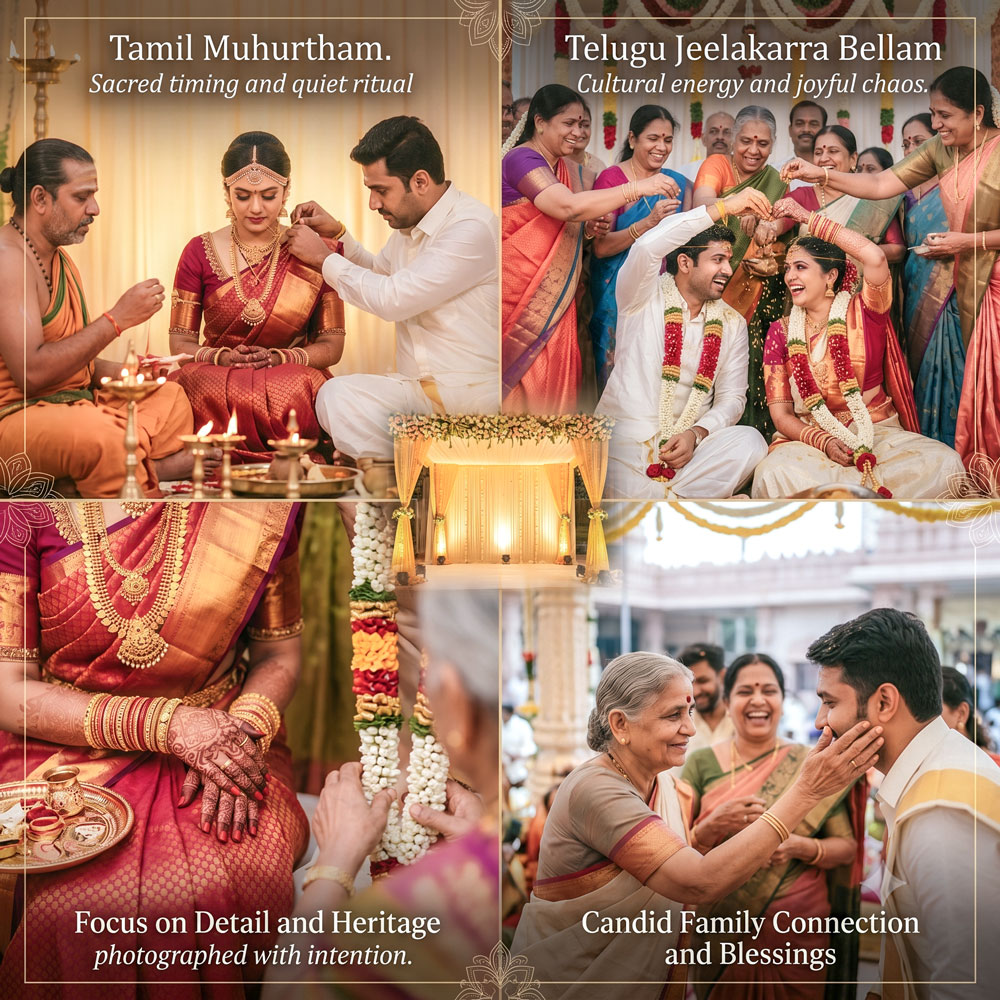
A Tamil muhurtham at first light and a Telugu jeelakarra bellam ceremony later in the day ask very different things of a camera team. One demands sensitivity to quiet, sacred timing. The other calls for precise anticipation, cultural fluency and the ability to read emotion before it surfaces. That is why Tamil and Telugu wedding photography services should never feel generic. These celebrations move with depth, symbolism and scale, and the imagery must do more than record what happened. It must preserve heritage with elegance.
For couples planning a refined South Asian wedding, the real question is not simply who can take beautiful photographs. It is who understands the rhythm of the rituals, the visual language of the families involved and the emotional arc across multiple events. In Tamil and Telugu weddings, details matter. The exchange of garlands, the placement of the thali, the moment elders step forward with blessings, the layered grandeur of silk, gold, florals and temple architecture – each carries meaning, and each deserves to be photographed with intention.
Tamil and Telugu weddings often unfold across several events, with each ceremony carrying its own cadence, family dynamics and visual texture. A photographer who is unfamiliar with these traditions may still capture attractive portraits, but that is not the same as building a complete visual narrative. Luxury wedding coverage begins with cultural awareness.
Tamil weddings are often rich in sacred structure. From the Kashi Yatra and Oonjal to the tying of the mangalsutra or thali during the muhurtham, the sequence is deliberate and deeply symbolic. Telugu weddings bring their own striking ceremonial language, including the jeelakarra bellam ritual, the mangalasnanam, the talambralu and the emotional significance of kanyadanam. These are not interchangeable moments. They require a team that knows when to stay unobtrusive, when to step in with gentle direction, and when to widen the frame to honour the presence of family and tradition.
There is also the matter of pace. South Asian weddings rarely move in a straight line. Timelines shift. Guest counts expand. Ceremonies can run beautifully late because elders are blessing, relatives are arriving, or a meaningful custom deserves more time. Premium coverage is not about forcing the day into a rigid production schedule. It is about staying composed, visually disciplined and ready for the unscripted moments that often become the most treasured images.
The finest wedding photography in this space balances three things at once – ritual, portraiture and atmosphere. If one of those is neglected, the story feels incomplete.
Ritual coverage must be exact. Hands, expressions, sacred items, priest-led proceedings and family interactions all need careful attention. In many Tamil and Telugu weddings, small gestures carry immense emotional weight. A bride’s parent adjusting her saree before the ceremony, the groom’s expression during a blessing, the laughter that breaks the formality of a solemn ritual – these are the frames that give the gallery its emotional intelligence.
Portraiture, however, still matters enormously. Luxury couples do not want only documentary coverage. They want editorial finesse. The richness of Kanjeevaram silk, heirloom jewellery, temple-inspired decor and carefully styled bridal dressing deserves refined, beautifully lit portraiture. A strong team knows how to create these images without interrupting the natural flow of the day. That balance is where experience shows.
Atmosphere is the third layer and often the one that separates standard event coverage from cinematic storytelling. Grand entrances, incense drifting through morning light, the scale of the mandapam, the collective energy of both families, the elegance of a reception transformation – these details establish place, mood and memory. Without them, a wedding gallery may feel technically complete but emotionally flat.
Some couples begin planning with a detailed list of must-have photographs. That can be useful, especially for family combinations or key ceremonial moments. But in Tamil and Telugu weddings, no list can replace intuition.
A culturally fluent photographer reads the room. They know when a grandmother’s reaction is as important as the main ritual. They understand that elders may value reverence over theatrical posing during certain parts of the ceremony. They can recognise when a moment is building and position themselves before it peaks, rather than reacting after it has already passed.
This matters even more in multicultural weddings, where Tamil or Telugu traditions may sit alongside another cultural or religious ceremony. In those celebrations, visual storytelling requires sensitivity to both sides of the family and a sophisticated understanding of how to represent each tradition without reducing either to token moments. The work should feel cohesive, not segmented.
When couples search for Tamil and Telugu wedding photography services, they are often comparing portfolios that appear polished on the surface. The deeper difference lies in consistency under pressure.
Ask whether the team can handle a full wedding weekend with the same creative discipline from the first pre-wedding event to the final reception dance floor. Ask whether they photograph people with sophistication, not just decor with style. Ask whether their imagery reflects an understanding of South Asian ceremonies, or whether it relies mostly on universal wedding poses dressed in cultural clothing.
A premium studio should also know how to manage scale. Large family structures, interstate guests, multi-day coverage and tightly layered run sheets all require calm coordination. This is especially relevant for couples hosting weddings in Melbourne, Sydney or destination celebrations across Australia, where logistics can become as complex as the ceremonies themselves. Beautiful imagery is only one part of the service. The other part is trust.
There is, of course, an important trade-off to consider. Some couples prefer highly directed portrait sessions with a fashion-led feel. Others want a more observational approach that prioritises spontaneity. Neither is inherently better. It depends on the couple, the family dynamic and the flow of the events. The strongest photography teams can do both, shifting between editorial polish and unobtrusive storytelling without losing consistency.
Tamil and Telugu weddings often present visual conditions that test technical skill. Early morning ceremonies can involve low natural light followed by harsh daylight. Indoor halls may combine mixed lighting sources, vivid stage colours and reflective surfaces from jewellery and silk. Evening receptions introduce a different challenge again, where ambience matters as much as clarity.
This is where mastery of light becomes essential. Fine-art photography does not happen by accident in demanding environments. It comes from understanding skin tones, preserving the richness of fabric and gold, and shaping images so they feel luminous rather than overworked. For luxury couples, editing should enhance the grandeur of the day while remaining timeless. The goal is not trend-led drama. It is enduring elegance.
Styling and timing also influence the final result. A bridal portrait session before the ceremony creates room for composed, editorial imagery. A short couple session between events can capture the emotional exhale after the formalities. Family portraits organised with intention can feel elevated rather than rushed. None of this needs to feel intrusive, but it does benefit from planning with a team that understands how to protect time for imagery without compromising ceremony.
At the premium end of the market, wedding photography is not a transaction for files. It is the creation of an heirloom narrative. Tamil and Telugu weddings are especially deserving of that approach because they carry such visible continuity between generations. The jewellery may be inherited. The rituals may have been followed by parents and grandparents. The blessings spoken over the couple often hold decades of memory behind them.
This is why the imagery should feel substantial. Not stiff, not overly performative, and never generic. It should feel like the wedding itself – intimate in the right places, grand where it needs to be, and deeply aware of what each moment means.
For couples who want photographs that honour both beauty and belonging, the standard to look for is simple. Choose a team that sees your wedding not as a schedule of events, but as a living piece of family history. When that perspective guides the work, the photographs stay with you differently. They do not merely show how the day looked. They remind you why it mattered.
For couples planning Tamil and Telugu weddings in Melbourne, the story of the wedding often extends beyond a single venue. It moves across familiar neighbourhoods where families live, prepare, and celebrate together. In many cases, the day begins quietly at home, continues through ritual spaces or community halls, and finishes later in grand reception venues filled with extended family and friends.
Much of this happens across Melbourne’s growing South Indian communities, especially in the western and south-eastern suburbs like Tarneit, Truganina, Point Cook, Hoppers Crossing and Werribee. These areas have become natural gathering points for Tamil and Telugu families, where weddings often feel both deeply traditional and distinctly Melbourne in character.
On the other side, suburbs such as Dandenong, Keysborough and Noble Park bring a different rhythm — often busier, more layered, with larger family networks coming together under one roof. These weddings are full of movement, emotion, and constant interaction, which naturally shapes how they need to be photographed.
Even further across the city, areas like Clyde North, Cranbourne, Berwick, Sunshine, Melton and Wyndham Vale often host larger venues where receptions unfold with music, dance and long family evenings that stretch into memory-making moments.
In this context, Tamil and Telugu wedding photography in Melbourne becomes less about isolated “perfect shots” and more about following the natural flow of people, places and rituals. The value lies in recognising how each suburb, each home, and each venue contributes to the overall story — and capturing it in a way that feels honest, unforced and connected.
